
Is the Bible truly God's Word?
Have you ever asked God point-blank, “Is the Bible truly your Word?” This is one of the most important questions we can ask our Lord, and he will answer those who sincerely ask because that’s just who he is. He is a God of clarity and a God of revelation. His answer might not come in a euphoric epiphany or an emotional experience, but his answer will come to those who sincerely ask.
I asked God that question after the fateful revelation in 2007 about my hidden unbelief about his word. God initially led me in the form of inquisitiveness. A million other questions suddenly surfaced, questions I had never voiced before.
Who wrote these individual books?
When were they written? How do we know they are still in their original form? Who decided that these books would be compiled into one big book called the Bible? Are there other writings that didn’t make the cut? Who translated them into other languages? The questions went on and on.
I realized that I had suppressed these questions mainly out of fear. I was afraid to ask these questions because I didn’t want other Christians to think I was questioning the inerrancy of God’s Word. I was afraid to voice my unbelief. I was a Bible study leader and a respected member of the church by this point. I felt like I had a lot to lose by sharing my confusion and doubts. I was also afraid to ask these questions because they could prove my doubts about the truth of God’s Word. It’s one thing to disbelieve the veracity of Scripture based on cursory knowledge, but what if a thorough examination led to hard and undeniable proof that God’s Word was a total fabrication? Then my faith would come tumbling down like a house of cards. But it dawned on me that God wanted me to ask these questions. These questions did not offend or unsettle him. He invited and aroused these questions so I would know his Word better. So I would know him better.
You might doubt the veracity of certain parts of Scripture; and perhaps doubt and confusion have set in in other areas of your life as well. It could be a fractured relationship, mounting bills, health concerns, or a relational rift that might make you wonder how your salvation intersects with the daily grind. You thought accepting Christ would solve your problems, but Jesus seems rather far off. You hear that he loves you, and you desperately want to believe this is true. But if you’re honest, your soul feels cold. If your life seems confusing, imbalanced, or lacking in hope, God wants you to turn to his Word.
But why would you turn to his Word unless you know that it’s truly from him? It can be a vicious cycle of grasping and hoping, doubting and wondering, and pondering how our relationship with Jesus can seem stunted in daily living. If so, the best place to run is to the Scriptures—even if you’re unsure of its veracity. Read it, meditate on it, examine it, and pray it. Also engage with it, asking God to grant you the knowledge and faith to understand his Word. He will meet you on those pages and orchestrate divine appointments and thoughts to bring you to the truth of his Word. The Word of God promises what no other book can promise, because the Bible is God offering his own heart to us. Although our Savior is always the same, our salvation stories are personal and nuanced. The same can be said of our relationship with the Scriptures.
My brother’s story drives home this point. Henry, who is now a criminal prosecutor, previously found himself on the wrong side of the law. He made some poor choices as a teenager and ended up in jail. At a very low moment in his life, sitting in solitary confinement, he looked around his cell and saw a lone piece of literature: the Gospel of John. He wasn’t a follower of Jesus, but desperation made him pick up this book. As he read, he felt a divine presence enter the room and into his soul. His reading of the Word made him believe in the possibility of God’s existence—in the possibility that the divine and carnal intersect, that hope can be found in the most unexpected places.
This type of experiential interaction with the Word is certainly a gateway into knowing Jesus more, whether as Savior or the Word. Start there, whichever verse the Lord speaks to you. Hang on to that verse or passage for dear life and then ask him to speak more through his Word. Along the way, continue to attend church, listen to sermons, join a Bible study, and read books that point to the formation and elucidation of Scripture.
My own journey, combining these elements, took many years. A pivotal moment came when I experienced the power of the Scriptures in a life-altering way. This was the year that Josephine, my daughter, was born, which turned out to be the hardest year of my life. A few months after giving birth I was diagnosed with a condition called a “petrous apex mucocele” that had gotten out of hand, and I lost hearing in my right ear and feeling on the right side of my face. My surgeon told me that I would eventually lose all hearing and all feeling if left untreated. After the diagnosis, I started having panic attacks, where even in broad daylight and open spaces I felt like I was drowning. Then I started feeling dizzy and blurry in my vision, and I went through more scans and tests than I can remember.
I was extremely fortunate to have a compassionate and skilled doctor who spent hours talking with me about all the options available. Doug and Julie, my pastor and his wife at our church in Woodland, California, walked alongside us every step, offering an incredible amount of prayer and counseling. Brian, my husband, was nothing short of heroic. But it was God’s Word that broke through the madness.
One evening, I came across Scripture reminding me of God’s love and sovereignty. Those words felt like lightning entering my soul, and I wept and laughed in unison. In that moment, I felt a divine joy, sustaining peace, and deep cleansing of my soul that can’t be fully explained in human vernacular. It felt like a light had dawned in pitch darkness.
One evening, I came across Scripture reminding me of God’s love and sovereignty. Those words felt like lightning entering my soul, and I wept and laughed in unison. In that moment, I felt a divine joy, sustaining peace, and deep cleansing of my soul that can’t be fully explained in human vernacular. It felt like a light had dawned in pitch darkness.
I savored the words and meditated on them, praying them over my soul. Those verses ushered me to meditate on God’s character and how much he loves me and is so worthy of being trusted. And eventually my fears about my surgery and all the what-ifs slowly receded.
Each fear based on a what-if was replaced with God’s holy presence and promise. What if I can’t take care of my newborn? God loves Josephine more than I do and will care for her regardless. What if the surgery is a failure and I lose all hearing and feeling on that side? God formed me in my mother’s womb, continues to sustain my every breath, and is mindful of my frame. What if I don’t survive the surgery because of some accident? God knows the exact moment of my last breath on this planet, and nothing can thwart his best and loving plans for my life. He is sovereign, he is good, and he is so very much in love with me.
Soon after that experience, I asked God, “How did all this come together? And how did your Word become what it is?” I heard nothing right away, but soon after, a friend recommended that I read New Testament scholar F. F. Bruce’s The Canon of Scripture. I had started digging around for answers for over a year at this point, but Bruce’s book was like none other. From defining the term canon, to covering the compilation of both the Old and New Testaments, Bruce’s book served as a textbook of sorts. From there, God stoked a love for his Word, both in content and canonicity.
God’s Word entered my soul like lightning. But this moment was not singular. It sparked a lifetime of delving into the Scriptures, where newfound discoveries awakened greater love for the Bible. But it has also brought me to deeper wrestling with Scripture, where certain verses have left me confused or certain parables remain enigmatic. I explore the hard questions, not in order to believe that the Bible is truly God’s Word, but because I already believe by faith and reason that it is.
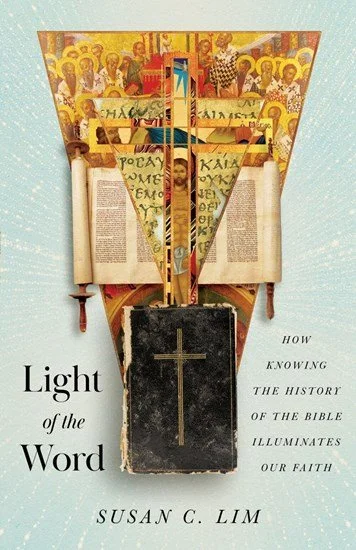
Adapted from The Light of the Word by Susan C. Lim. ©2023 by Susan C. Lim. Used by permission of InterVarsity Press. www.ivpress.com.
The views expressed in this blog are those of the author and do not necessarily reflect those of the Jude 3 Project. Content is for informational purposes only. Some posts may feature guest contributors. To inquire about writing for Jude 3, contact us at blog@jude3project.com.